
Forecast immersive features by mechanism, not hype
Headset announcements can prompt confident forecasts, but a component demo does not show that gambling improved. Separate today's device capability from what browser, privacy and distribution changes might allow later. Each roadmap step needs a measurable user problem, evidence threshold and review date or trigger.
Three factors shape product decisions: device capability, standards maturity and service regulation, and they move at different speeds. Headsets may improve passthrough while browsers remain uneven; standards may advance before implementation; and improved usability can create new camera or microphone issues for operators.
New Zealand's regulatory baseline is changing. DIA says the Online Casino Gambling Act 2026 is in force and expects the licensed regime to be fully operational in 2027, with staged rules for advertising and eligibility. Put regulatory checkpoints beside prototype and rendering milestones.
Current capabilities and signals to monitor
| Signal | Possible product effect | What would confirm progress |
|---|---|---|
| WebXR implementation | More browser experiences can enter an immersive mode without a native app. | Standards maturity, interoperable browser tests and reliable support on the intended New Zealand devices. |
| WebGPU support | Browser workloads can use newer GPU features for rendering or computation. | Stable implementation across target browsers, adapters and device classes. |
| Passthrough and spatial mapping | Table interfaces can sit in a physical room or preserve more environmental context. | Consistent tracking, clear permissions and usable safety boundaries in real settings. |
| Hand and eye input | More direct selection and control can reduce reliance on controllers. | Accessible alternatives, low error rates and a privacy case for the sensor data collected. |
| Shared spatial rooms | Live hosts or players can share a scene instead of a flat video layout. | Moderation, latency alignment and a measurable improvement to a task users value. |
WebXR and WebGPU work was still active in 2026, making browser support a moving dependency. A specification's publication state helps planning, but release decisions need a tested browser, headset and operating-system combination. Recheck the official spec when setting milestones.

Three scenarios for product planning
Optional browser layer: add spatial tables or a host view to a conventional site through browser APIs, reusing account services and content. Feasibility depends on feature support, headset browser access, secure-context rules, frame performance and a non-immersive fallback.
A native headset app can use controllers, tracked hands, persistent rooms and richer sound to support social play. Distribution, runtime updates, store rules and device testing increase operating costs. Account and safer-play functions must still work both in-headset and on the standard web account.
A phone or headset can serve as a spatial companion for a table, event or learning guide while regulated play stays on a regular platform. This can test whether spatial information helps understanding with less product change. Camera use, interaction and marketing still need boundaries if it links to wagering.
Do not forecast adoption from a technology demo
A convincing room-scale prototype shows that a scene can be built, not that customers own compatible hardware, prefer it or complete tasks better. Forecasts need reach, setup, accessibility, purpose-specific return, support demand and failure data. Session length alone can reward time spent without demonstrating value.
Use clear release gates: prototype, task evaluation, device compatibility, limited release and monitored operation. Compare spatial and flat versions at each stage. If an account task slows or safety tools become harder to reach, the immersive version has not justified its extra complexity.
- Measure whether people can locate rules, limits and time without leaving the experience.
- Record failed launches by headset, browser and runtime.
- Track declines for camera, microphone and hand-tracking permissions.
- Review support requests for dizziness, lost controls, disconnection or unclear game state.
- Set a guardrail for accidental actions and unresolved rounds before the pilot starts.
New Zealand regulation will shape interface choices
Treat player safeguards as fixed in every scenario. Test whether the spatial feature improves access to controls; fail the gate if it hides time, delays breaks or starts actions without a distinct confirmation.
At each milestone, confirm the product classification and current release authority. Store the source, owner and review date with the roadmap instead of embedding a time-sensitive rule in permanent interface text. Reopen review if wagering, audience or promotion changes.
Assign camera, gaze, voice and hand signals to specific tasks. Record whether raw samples can stay on-device and what happens if access is declined. Identity matching and behavioural inference need separate releases, named owners and fresh assessments.
Player safeguards cannot wait for better hardware
Better hardware does not remove pressure from continuous access, social prompts or rapid interaction. Add safer-play measures to the first prototype: show balance and net position in text, keep elapsed time visible in full screen, separate a new wager from a held trigger, and make breaks accessible in a stable panel. Retain a regular account route when the headset comes off.
Review social signals specifically. Public rankings, celebrations and hosts urging another round alter the experience. Support conversation without exposing private account details or rewarding longer sessions. Keep avatar settings independent of financial status.
Distinguish device readiness from user value. Visual parity does not mean rules are clearer or controls easier. Before funding a mode, state the task, evidence of improvement and data-collection stop condition, then review with product, privacy and player-safety owners.
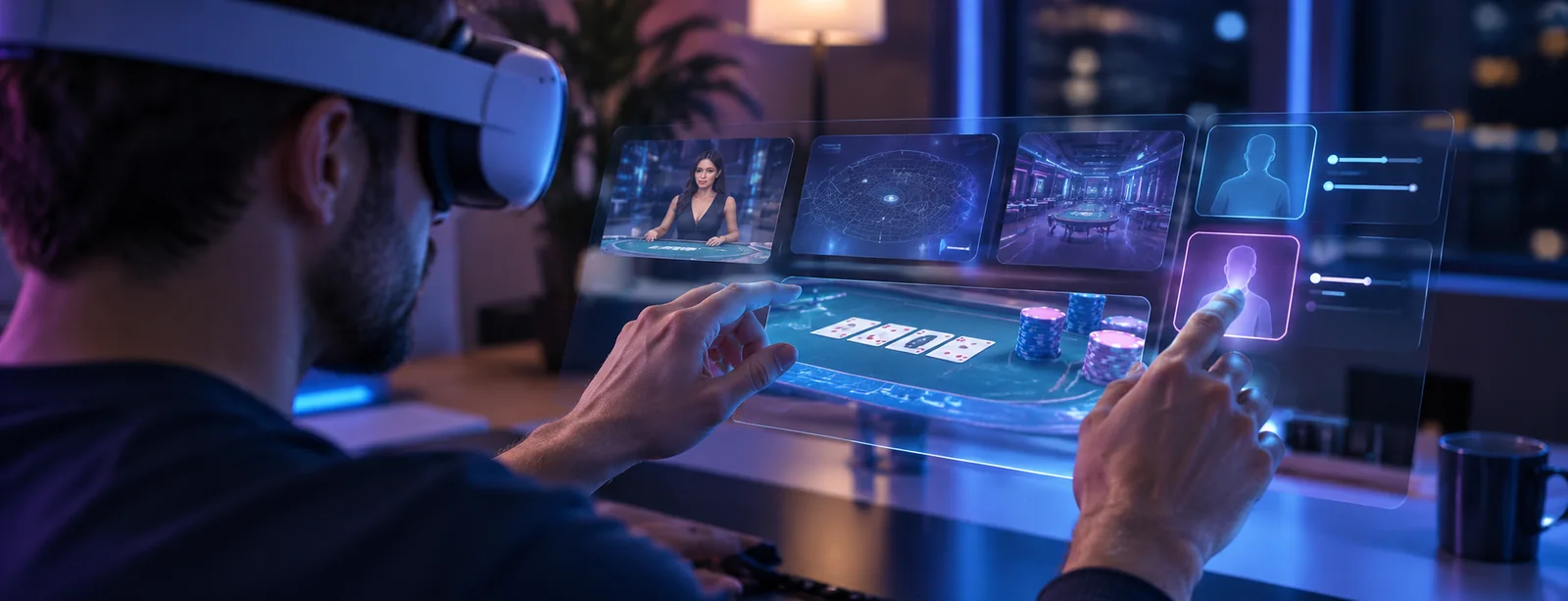
Roadmap gates for an immersive feature
Decision gate for an AR or VR capability
- Use-case
- Question:Which user task requires spatial presentation?· Required evidence:Observed comparison with an ordinary interface.
- Platform
- Question:Can target browsers or headsets support the interaction reliably?· Required evidence:Dated compatibility and performance matrix.
- Safety
- Question:Can users reach controls, support and exit from every mode?· Required evidence:Task tests with seated, reduced-motion and non-camera flows.
- Privacy
- Question:Which sensor data is collected, inferred, transmitted or stored?· Required evidence:Data-flow map and necessity assessment.
- Regulatory
- Question:Is the feature part of a New Zealand online casino service?· Required evidence:Current legal classification and named review owner.
- Release
- Question:What happens when tracking, network or rendering fails?· Required evidence:Recovery tests and rollback criteria.
Headset ownership limits who can use dedicated VR; browser delivery reaches other devices but may not support identical spatial input. Keep a usable flat fallback for anyone whose hardware cannot run immersive mode.
Use update triggers instead of fixed forecasts
Attach an owner and review trigger to each assumption. After major browser or W3C changes, recheck XR compatibility. When a target headset changes input modes, rerun the device matrix. Review New Zealand wagering features at each DIA licensing milestone.
Revisit the roadmap when evidence changes: cross-browser WebXR tests work, a named headset improves, setup failures fall, privacy controls become clearer, mobile performance steadies or spatial presentation improves a defined task. Pause investment if the expected condition does not appear.
At every review, record which device test, product result or regulatory change moved a scenario past its evidence threshold.