
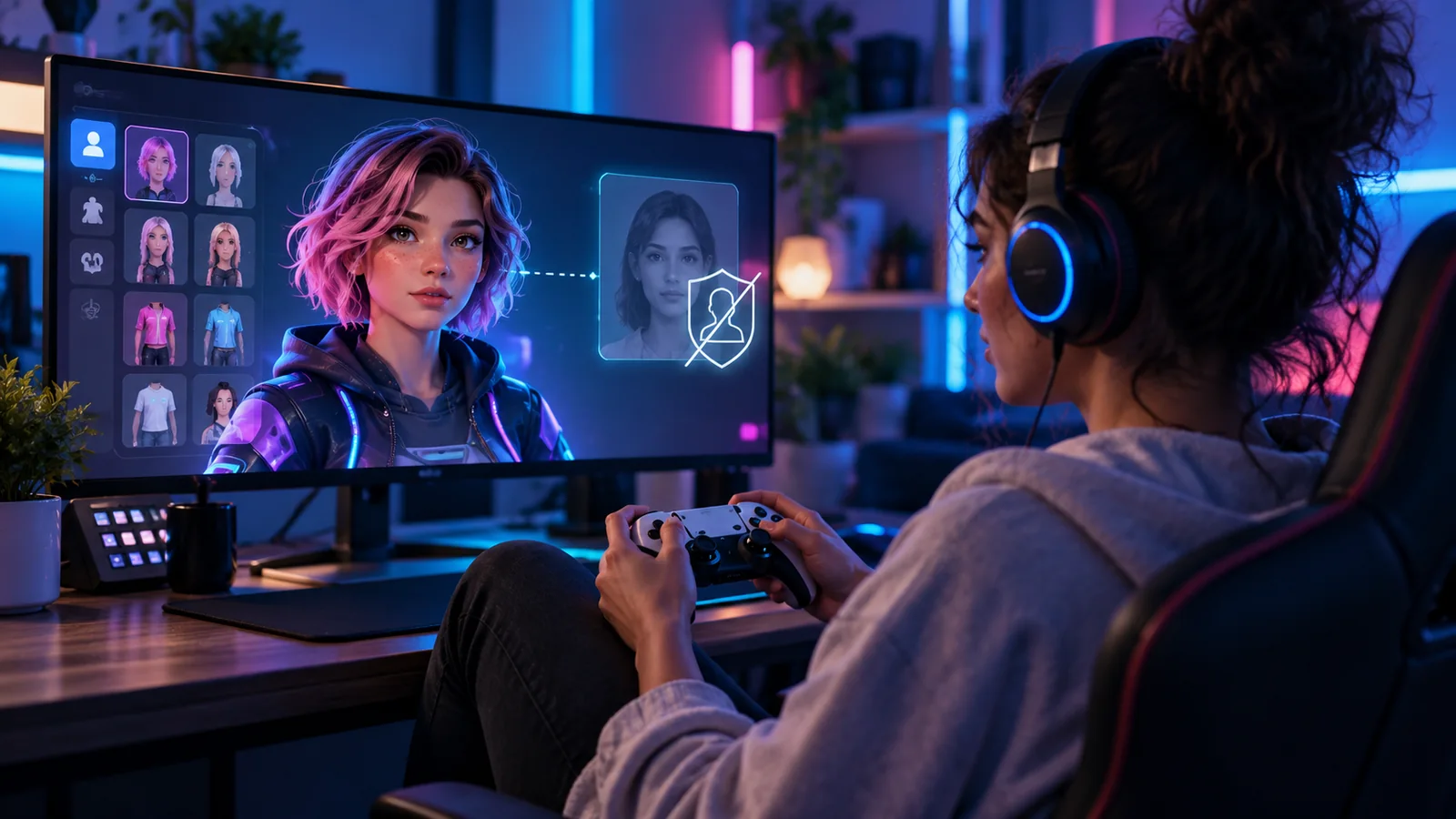
An avatar is an interface, not proof of identity
Two avatars may sit at one table while one person wants to talk and the other wants quiet. Proximity, voice, movement and profile choices shape the space before conversation begins. Make boundaries and moderation easy to reach, and keep avatar appearance separate from account identity or age checks.
Label whether a participant is a person, host, scripted character or automated opponent. Do not make an automated character look like a live user. If a human host is streamed into the room, mark it live and account for delay.
Verified identity stays with the secure account service. Rooms may use pseudonyms and chosen appearances, while payments, eligibility and rules stay attached to the account. Other players must not see balances, stakes, loss history, ID documents or safety flags.
Design social tools before adding shared rooms
Keep mute, block, report, personal space, avatar visibility, voice level and exit controls available during play. Muting speech should not remove captions or game-state text. Blocking should prevent future contact too, not only silence audio for a short time.
Social control and expected behaviour
- Personal boundary
- Required behaviour:Prevent other avatars from entering the selected personal area.· Evidence to retain:Setting state and interaction event, not unnecessary room recording.
- Mute
- Required behaviour:Silence a participant without disabling game information.· Evidence to retain:Local setting and moderation event if reported.
- Block
- Required behaviour:Prevent direct contact and reduce repeat encounters.· Evidence to retain:Account-level enforcement state.
- Report
- Required behaviour:Capture the relevant incident context under a clear policy.· Evidence to retain:Time, room, participants and report category.
- Leave room
- Required behaviour:Exit social interaction without submitting a wager or losing a settled result.· Evidence to retain:Session and game state on exit.
Moderation requires a named responder and escalation route; an unstaffed queue is not protection. Explain retention and deletion for voice, chat and spatial events. Do not record every conversation by default in case an incident happens.
Keep social pressure away from financial state
Rankings can turn private accounts into a contest. Do not order users by wagers, losses, rounds or time. A room can share a sports result or discuss rules without exposing anyone's finances. Explain prize terms and eligibility before an activity.
A host can frame another round as a social obligation. Let players sit out, mute or pause without losing access to friends. Provide a social area or activity that does not accept stakes, so returning to a group does not require gambling.
Support voice, text, passive viewing, mute, private tables and avatar-free use. Defaults should let people set boundaries without explaining them. Adapt controls to that need rather than turning demographic assumptions into a player score.
Use voice and body data only for defined functions
Audio, hand poses, gaze, expression and movement can all become personal data. Temporary voice transport may enable conversation, but does not justify storing recordings or analysing emotion. Document each signal's source, purpose, recipient, retention and deletion.
Do not use avatars as identity proof. If the product matches face or voice, estimates age or infers behaviour, define that as a distinct feature and assess it before launch. Players should be able to use standard avatars and text without sharing extra body or profile data.
Keep camera and microphone optional for account use. Provide text and preset non-verbal cues. Separate voice moderation from biometric identification; do not derive identity from animation or gambling intent from gaze.
Avatar inclusivity takes more than cosmetic options
Offer a neutral avatar without requiring body shape, gender or skin tone. Let users adjust size, visibility and display name, or hide the avatar and use a marker. Distinguish controller from hand-tracked representations so others can tell how movement is produced.
Provide captions and keyboard or controller access to social controls, plus non-verbal gesture alternatives. Avoid rapid flashing or unexpected scaling. Include seated and low-motion modes; presence cannot depend on eye contact or copying a gesture.
Test moderation and privacy with intended users, including disabled people and, where relevant to audience policy, young adults and people affected by gambling harm. Identify controls that are hidden, slow or difficult while someone else is speaking.
Social design still needs platform-level safeguards
Social spaces must respect account restrictions. A new avatar or private room cannot restore play to a timed-out or self-excluded account. Keep the room's response neutral so others cannot infer why someone left.
Keep elapsed time, session settings and support in a stable room menu. Do not announce time-outs or self-exclusion to other participants. A private notice can explain the restriction without exposing sensitive reasons.
Separate room Inspection, avatar setup and game entry. A conversation space can provide moderation without automatically adding wagers or promotions. Review the full route from invitation to game.
Review the social feature as a complete session
- Join with voice and camera permissions declined.
- Mute, block and report a participant while a round remains active.
- Leave the room mid-round and verify the financial state separately.
- Check that no avatar, name or emote reveals account or loss information.
- Take a break and return without social prompts creating a new wager.
- Confirm moderation access is limited and incident retention has an expiry.
Track reports per room-hour, repeated contact, completion of mute and block, moderation response time and ability to leave without losing game information. Chat volume or time in-room alone does not show social value.
Because controls sit in a spatial scene, users must reach mute, block, report and exit without reusing social gestures. This keeps moderation actions apart from game input.

Moderation should account for voice and spatial contact
Abuse may involve speech, repeated proximity, blocking sightlines or following someone between rooms. Write rules for each channel: mute cannot stop crowding, and a personal-space boundary cannot stop harmful speech.
Offer temporary room controls and account-level penalties with review. Confirm receipt of event reports, restrict access to evidence and log moderator actions. Delete incident material at the stated retention date.
A social feature should not require someone to reveal a legal name to other players. Keep verification within the account service and expose only the display information the room needs.
Test inclusion without forcing self-disclosure
Allow default markers, text participation and avatars without gender, body type or facial likeness. Ordinary controls must not require sensitive profile details. Seated mode or voice-off should not require users to explain a disability.
Review avatar options with disabled users and communities the product intends to serve. Apply feedback to representation, privacy defaults, moderation and navigation. Keep user feedback separate from accounts and do not infer identity from avatar choices.