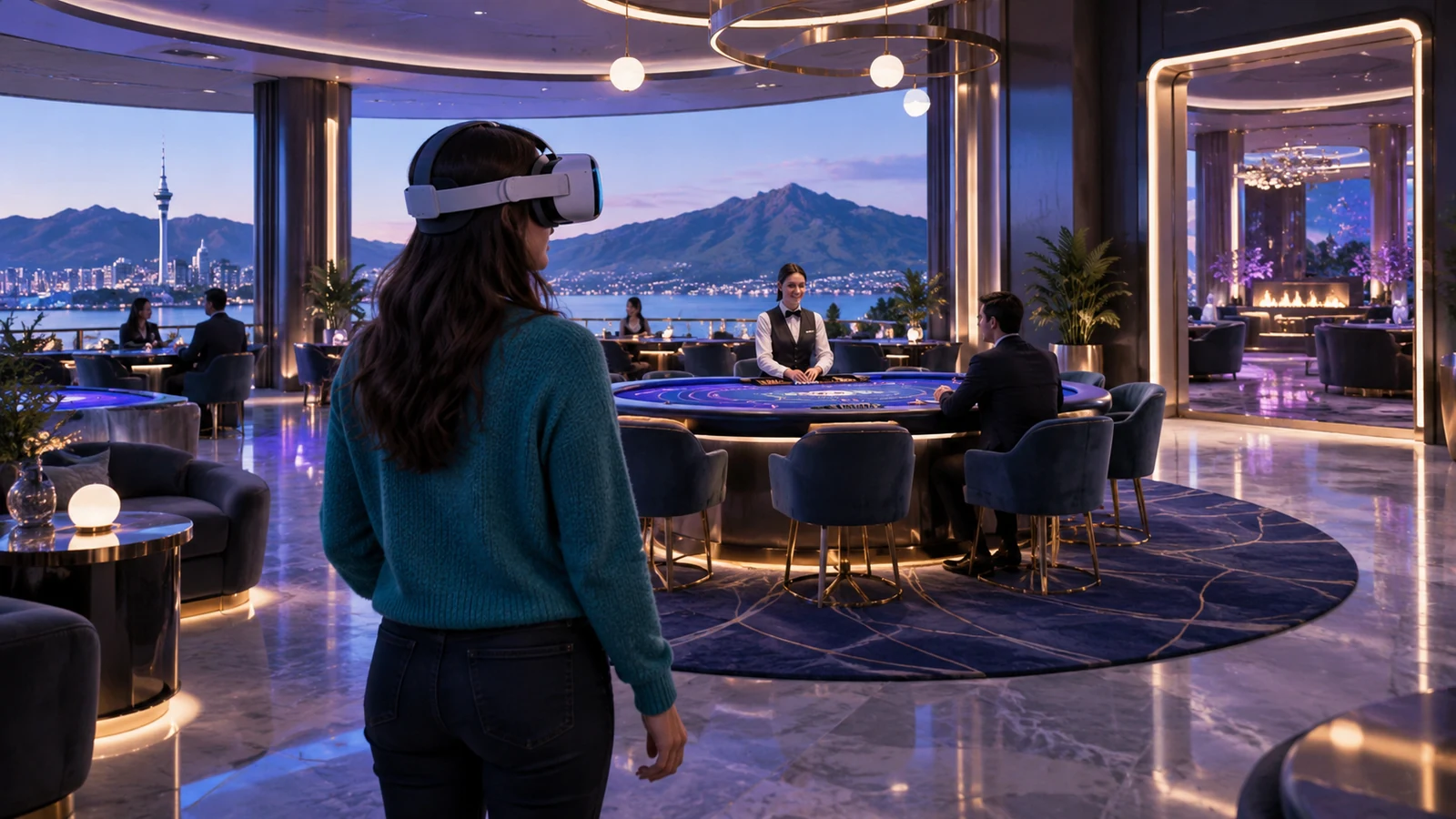
A headset changes the room, not the obligations
A new headset user turns toward the nearest table and immediately looks for the rules, account balance and exit route. That information cannot be buried behind an avatar or a controller shortcut. The opening session shows whether room layout, account access and social features help a player get oriented or simply add activity around them.
The design goal is a gambling interface that stays legible in a headset, not a venue recreated in photographic detail. A realistic roulette wheel says nothing by itself about the odds or fairness of a result. Those depend on the game service and its auditable event record. Animation should reflect a state the game system has accepted and should never imply a result before settlement.
A headset room still belongs to the casino service behind it. Before enabling real-money play or marketing a VR experience in New Zealand, verify the operator's current authority, transition conditions and advertising obligations. The service's activity and audience determine its legal classification; the use of a headset does not.
Choose a room around a task
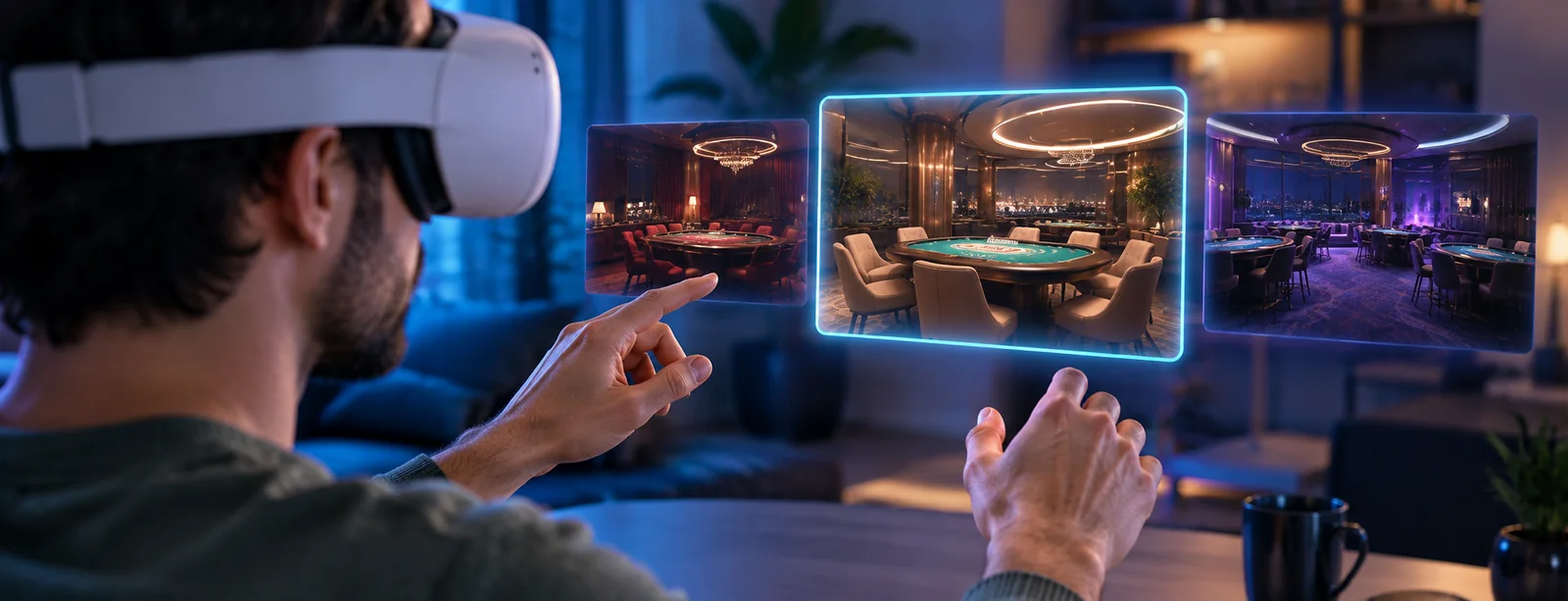
Give each virtual room a specific job. Tables can show one shared game state to several people; a host studio can place a live presenter clearly and make captions easy to follow. A quiet lobby can help returning players reach settings without constant sound, flashing signs or game prompts. If the room only turns a game list into a 3D scene, a regular page may be quicker.
| Environment | Good fit | Risk to control |
|---|---|---|
| Single-player table | Inspection of a compact game scene with stable position and clear controls. | Decorative motion competes with balance, stake and rule information. |
| Hosted live room | Shared attention around a real presenter, cards, wheel or game-show stage. | Stream delay makes avatars or overlays appear out of sync with the authoritative feed. |
| Social lounge | Conversation, orientation and non-wager activities between game areas. | Unmoderated voice, unwanted contact, pressure to keep playing or unclear room boundaries. |
| Lobby or account space | Settings, limits, history, support and access to rules. | Important account controls become hidden behind locomotion or spatial menus. |
Build the interaction around headset differences
Headsets vary in resolution, field of view, tracking hardware, controller layout, hand tracking and system functions. OpenXR gives supported applications a common API surface, but feature behaviour still varies by extension support, runtime and device performance. Check capabilities at launch and choose an interaction profile that has been tested for that setup.
Keep must-have controls on a stable head-locked panel without placing every object against the user's face. The table should stay in the room as the player turns; a compact account panel can appear at a comfortable distance when requested. Include a quick recenter command and seated mode. Essential tasks should work with the default controller and, where available, a simpler gaze or pointer option.
Choose locomotion deliberately. Teleporting reduces continuous visual movement but may make a room feel less natural; smooth movement offers direct navigation and can trigger discomfort. Account settings should not require a walk through the lobby. A static menu, adjustable movement and a predictable exit reduce the burden when a headset-specific issue occurs.
Keep trust information in the same space as play
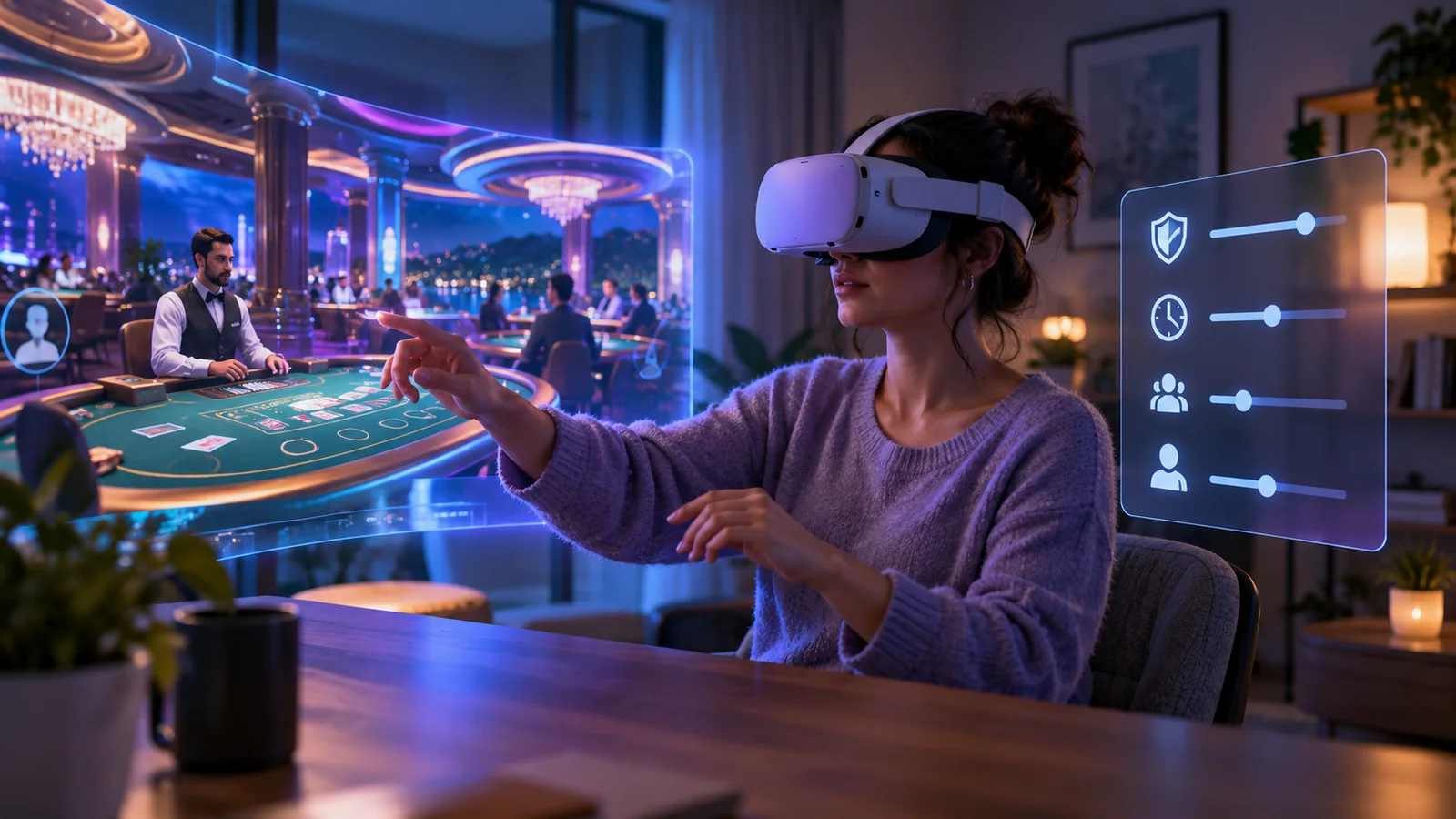
Players need access to opponents, rules, theoretical return, transactions and net position. Hiding these details in a distant panel or showing them only on request makes them harder to locate. New Zealand's 2026 minimum standards specify information and controls for regulated gambling platforms, including clear rules and odds, visible net position, time information and a deliberate start between rounds.
Use a consistent place in the VR layout for money and game state. Put the stake and result beside the action that changes them; keep rules and controls in a persistent, labelled panel. Voice should not be the only channel: nearby people, recognition errors and poor auditability make it unreliable. Caption speech and display confirmation after the service accepts an action.
- Show whether an opponent is a person, a host or a computer-controlled participant.
- Keep the clock or elapsed time visible in full-screen headset applications.
- Prevent gaze dwell or a held trigger from starting another round automatically.
- Display account limits, time-outs, breaks and self-exclusion options from the room's main menu.
- Explain what the platform does after a network interruption before the person returns to play.
Presence has social and moderation costs
Avatars help show turn order and seating, but they can also expose speech, gestures, body movement and proximity. Let players manage personal space, mute or block others, hide their avatar and report incidents. Moderation needs to respond during play, with a way to retain evidence of an incident without keeping unrelated conversations indefinitely.
Social pressure can build without a direct demand. Celebrating wins loudly while keeping losses quiet changes the emotional tone; public balances, leaderboards and congratulatory effects can make private financial activity performative. Keep account details private from other players and label social activity separately from wagering in the interface.
For live or host-led rooms, specify who may speak or change the scene, which server clock governs the round and how reconnects work. Presenter and player views can differ while still showing the same auditable result. The service also needs a recorded rule for voiding, settling or resuming a game when someone disconnects mid-round.
Safer play controls need a headset-native route
Safer-play features are ineffective if players cannot reach them. A headset user may have moved the device, removed glasses or lost a controller. Keep a stable support panel in the system interface, allow text scaling and provide the same settings on web or mobile. Raising a limit or ending a break must not be triggered by a quick confirmation gesture.
DIA standards require access to time, deposit and spend limits after account opening; increases or removals of limits have a 24-hour delay. Breaks, time-outs and alerts have related protections, and the platform must check the self-exclusion register before activation and login. VR must not create a separate spatial route around account-level restrictions.
VR control design review
- Pause or leave
- Headset requirement:Visible, reachable without walking and distinct from a wager control.· Acceptance evidence:People can pause from seated and standing positions without hand tracking.
- Limits and breaks
- Headset requirement:Use plain labels, current values and confirmation for consequential changes.· Acceptance evidence:Test the 24-hour waiting rule and verify that lower limits apply promptly.
- Session time
- Headset requirement:Keep local time or elapsed time visible without a system menu.· Acceptance evidence:Check display under different time zones and headset full-screen modes.
- Disconnection
- Headset requirement:Explain whether the round is pending, completed or voided.· Acceptance evidence:Replay network loss at each game phase and compare account logs with UI state.
Operational tests should include the room's weakest moment
Measure the first minute as well as a stable demo. A newcomer may accept permissions, set the play area, learn a controller and join a live stream in quick sequence. Record completion, anchor drift, input failures, caption use, access to support and recovery from crashes by headset type and input. Average frame rate alone can hide a device where the money panel is unreadable.
Test late-night sessions in New Zealand time, weaker networks, muted audio, seated play, a disconnected controller and refusal of voice or camera permissions. Add crowded rooms and minimum-graphics settings. Keep a two-dimensional option for account tasks and let players leave VR without losing the game state recorded by the service.
Ask a first-time user to enter from the lobby, read a game's rules, inspect the account and leave without assistance. Then repeat with audio muted and one controller disconnected. Record exactly where an essential control becomes inaccessible.