
Make the game state clearer than the spectacle
At a virtual slot, the reels hold attention; at a virtual table, the turn does. Their spatial cues differ, although both need a clear stake, an accepted action and a settled result. Decide what belongs in the scene, what must remain text and how the client responds if a controller disconnects during a round.
A slot animation may pause or be skipped without changing an outcome the game has already determined. A roulette wheel may keep turning while the service processes a result, but it should not imply that the ball can still affect a fixed outcome. Cards may animate after a valid deal is recorded. Keep visual timing separate from wager logic so a render delay cannot create a duplicate round or hide settlement.
New Zealand's 2026 minimum standards cover round starts and intervals, time displays, rules, return-to-player information and net position. They set a minimum 2.5-second wait before another round and require a separate deliberate action to start it. These requirements constrain product behaviour even when the game uses an immersive scene.
Slots: translate a familiar loop into spatial controls
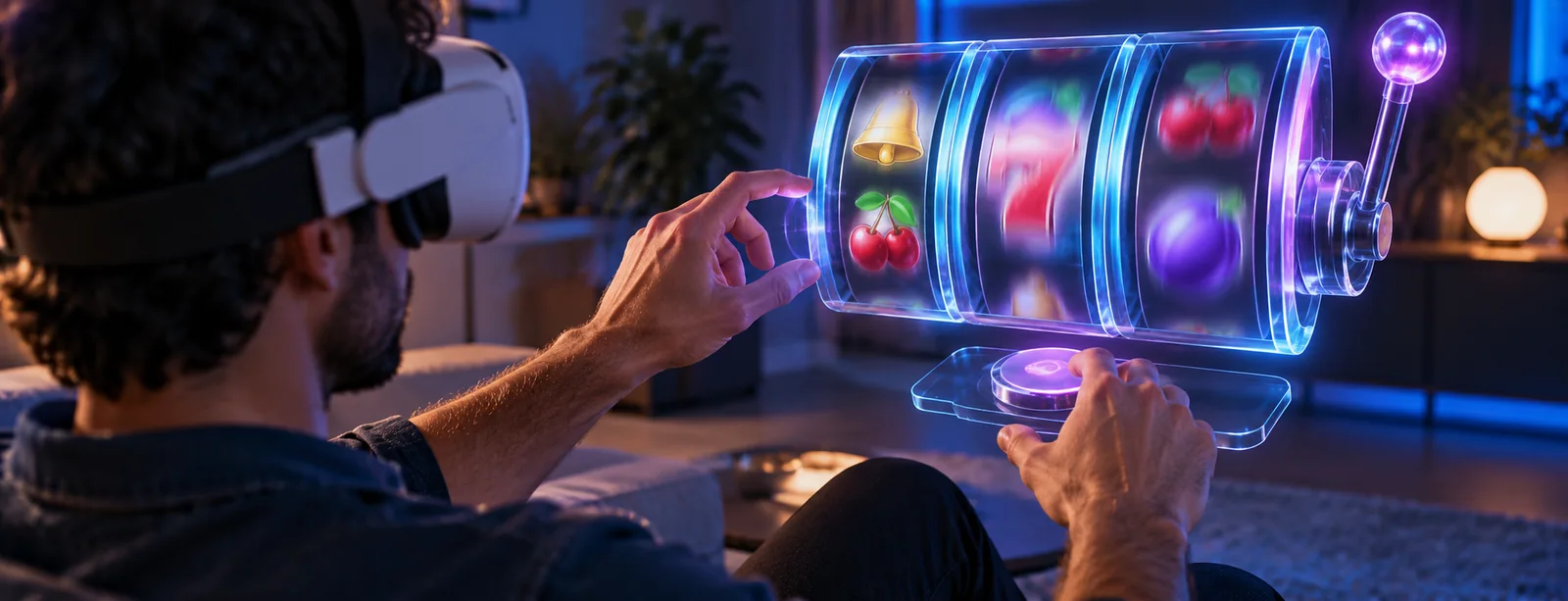
Three reels placed before a headset user may be easy to read, while a full floor of virtual machines can make orientation difficult. Keep the slot task focused: use a repeatable panel for the game name, stake, line or feature rules and last result. Make the paytable available before play. Explain bonus triggers and offer still or reduced-motion versions of visual effects.
Apply the same input boundaries in VR as on a touch screen. A trigger, pinch, gaze dwell or grip held from the previous move must not start another round. Show clear states for ready, active and settled play. Require a fresh press for the next round and separate that control from bet-size actions to limit accidental starts.
- Keep the available balance and session net position in text, not only as a stack of rendered coins.
- Place the stake control close to the start control, with a visible value before confirmation.
- Make paytable and feature rules available before a stake is committed.
- Keep rapid spin, autoplay or chained rounds from bypassing a separate deliberate action.
- Offer reduced-motion and audio-off modes without hiding the state change.
A spatial carousel may help users browse, but it cannot hide the limit panel or make account access depend on walking through a virtual space. From the active-game view, players should be able to stop and inspect information within a small, predictable number of actions.
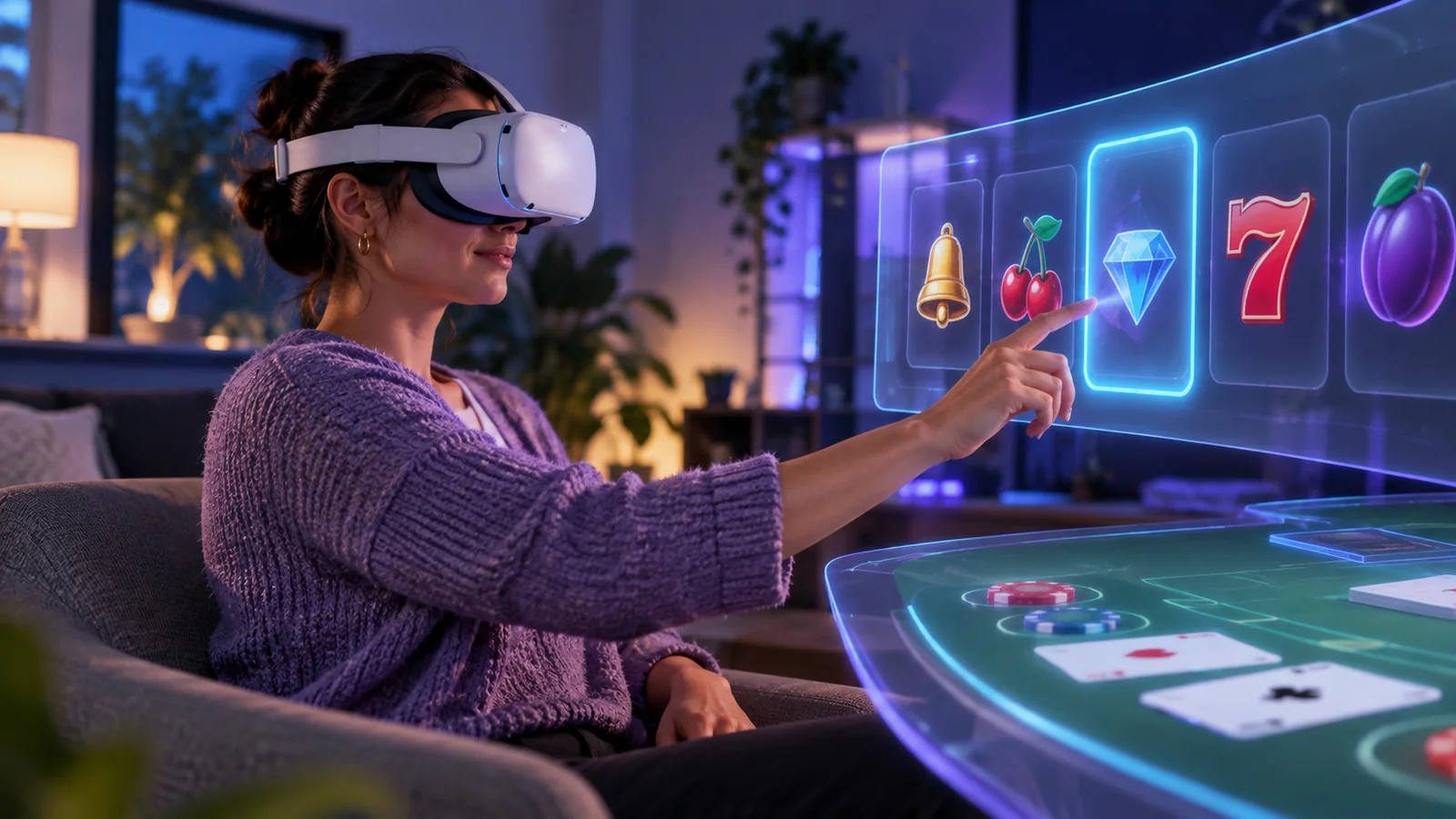
Table games: preserve turn order and shared information
Blackjack and poker depend on clear links between a player's hand, the dealer or opponent, available actions and the stake. Distance and position can show whose turn it is, but repeat the cue in text and labels that do not rely on colour. Players with limited vision, colour perception or hearing still need to know the available action and what others have done.
Roulette and baccarat depend on a shared table state. Let players inspect the layout and rules without starting a round. Zoom and adjustable seating can help, while stake and winning condition need a fixed numeric display. For live play, specify the authoritative feed, timestamp and game event. If video delay places a dealer gesture before betting closes, show the state explicitly rather than asking players to interpret the gesture.
Table-game information that should stay legible in VR
- Turn ownership
- Spatial cue:Seat light or highlighted player position.· Text alternative:“Your turn,” current phase and an explicit list of legal actions.
- Card rank and suit
- Spatial cue:Large, high-contrast card face with shape cues.· Text alternative:Accessible card label and adjustable card scale.
- Stake or chip value
- Spatial cue:Physical-size token with a stable colour and shape.· Text alternative:Numeric amount in NZD, shown before and after confirmation.
- Round status
- Spatial cue:Dealer or table animation following a settled event.· Text alternative:Waiting, action accepted, result settled or recovery needed.
Real-time rendering can obscure operational truth
A headset renders a separate image for each eye and refreshes it as the wearer moves. Missed frames can make objects jitter or drift. Do not let an attractive effect cover a value or shift a control; keep financial information on a stable surface and reserve heavy particle effects for moments that require no precise reading. Provide a flat or fallback view when the device cannot sustain the scene.
Validate state and suppress duplicate input. A controller event may arrive twice, hand tracking may flicker, or a request may retry after timeout. Send an idempotent action ID, show a pending state and lock the control until the server confirms the transition. After reconnecting, query the actual round state before offering another start.
Map implementation states such as idle, rules viewed, stake chosen, action submitted, round active, result pending, settled, interrupted and recovered. Specify permitted actions in each state. That map exposes cases missing from a motion-capture demo, including headset sleep during a pending wager or a controller change between rounds.
Safer-play tools belong inside the play surface
Keep the break route beside the current game state and let the account panel open without replacing the result view. Apply the same server-side settings in slot and table scenes even if their controls differ. When a limit changes, state whether it applies immediately or after a protected waiting period.
New Zealand's minimum standards pair account controls and self-exclusion with game-specific requirements. Check the self-exclusion register at activation and login. A spatial interface cannot treat each game as a new identity: apply one account limit across headset, browser and phone sessions, including a mid-session device switch.
Do not turn safer-play tools into rewards or bury them in settings. A small persistent indicator can show elapsed time and limit status without using win-or-loss colours. Interrupt active play with alerts at a predictable point and keep a break control available. Since a headset may obscure the system clock, provide a readable time display within the platform.
Comfort and accessibility are mechanics
Support seated play, a stable horizon, less animation, no forced movement and lower audio intensity. Include adjustable table height, left- and right-handed controls, larger text and a flat menu. Settings should not require reaching across the body or holding a controller at shoulder height. Offer recentering and an exit route that works without hand tracking.
Repeat essential information through different channels: caption a spoken dealer call, pair a flash with text and replace sound-only cues with a visible state. WCAG 2.2 includes relevant web criteria for keyboard use, flashing and motion-actuated controls. Use it as a baseline for companion pages and account panels, then test the VR game separately on its target headset and inputs.
Test the loop with safety and recovery measures
Measure whether people can locate a rule, check a stake and result, pause and resume an interrupted round, rather than time spent in a headset. Track mis-presses, duplicate events, unresolved states, control Inspection, frame drops near key values and visibility at different display scales. Include safeguards against accidental starts and missed time alerts.
| Scenario | Expected platform response | Record |
|---|---|---|
| Controller disconnects after stake selection | Keep stake state explicit; do not start a round from reconnection. | Input log and account event sequence. |
| Network drops after the start request | Show pending or settled status from the server before offering another round. | Duplicate request count and recovery time. |
| User opens rules mid-session | Pause or preserve the round according to published rules; do not trigger play. | Rule access time and round-state result. |
| Text scaling is increased | Keep stake, balance, rules and safer-play controls readable. | Clipping or overlap by supported resolution. |
Run one slot round and one table round with animation skipped, a sleeping controller and a delayed server response. Before the scene enables another action, verify the stake, accepted input, result and next state against the service record.