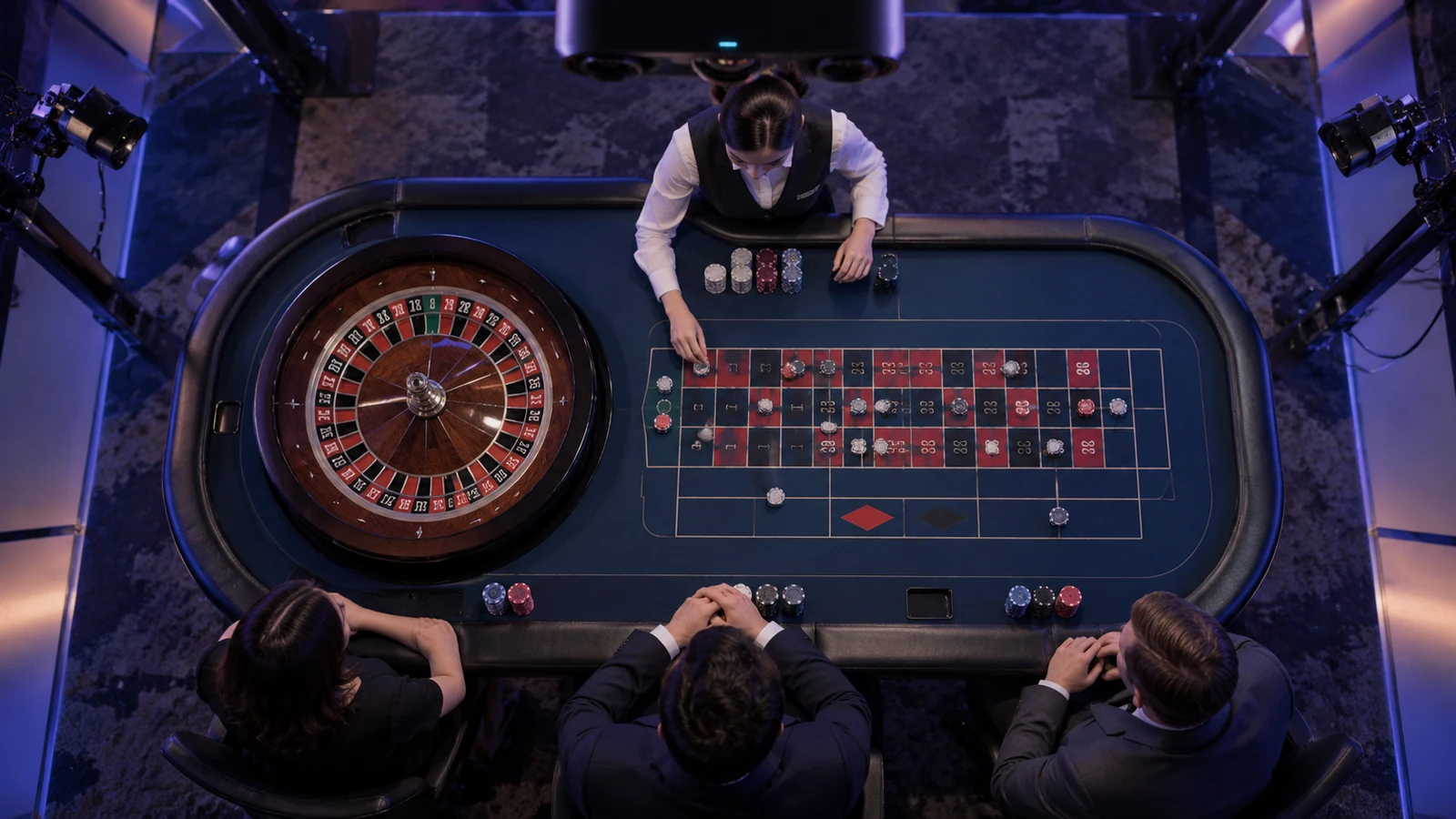
Computer vision adds a visual measurement layer
A camera system's useful output is more than a card-detection label. Operators need the table and round reference, the freshness of the view and the actions the system may take. Treat computer vision as a measurement service within a reviewable workflow; keep game logic and account records under their designated owners.
In casino operations, video can support monitoring, reconciliation and staff review, but an image alone cannot prove intent, identity or fairness. Lighting, angle, occlusion, blur and compression affect interpretation. Define the detectable event, retained evidence and the person or service that resolves uncertainty before deployment.
Link each visual event to the casino record with stable table, round and timestamp identifiers. A model may flag a mismatch, while the game service remains responsible for accepted actions, outcomes and balances. This gives operators evidence to review without turning pixels into a transaction ledger.
From camera frame to reviewable event
Separate the image-capture stages from the decision they support. Expose a status for each step so staff can tell whether a missing result came from camera failure, detection or a downstream service.
- Capture:Record frame time, camera ID, resolution, exposure and stream health.
- Calibrate:Correct lens distortion and map image coordinates to a known table or scene layout.
- Prepare:Crop relevant regions, normalise exposure and filter noise without discarding evidence.
- Detect:Identify objects or actions, with confidence and bounding coordinates.
- Track:Associate observations across frames and preserve object identity through short occlusions.
- Validate:Compare the proposed event with game rules, timestamps and an independent source.
- Respond:Accept, flag for human review or leave the event unresolved; keep the original event trail.
A detector may locate a card and classify its rank; a table-state service can check whether that card fits the expected dealing phase. If the view is delayed or the card is partly covered, flag uncertainty instead of silently adding it to the game record.
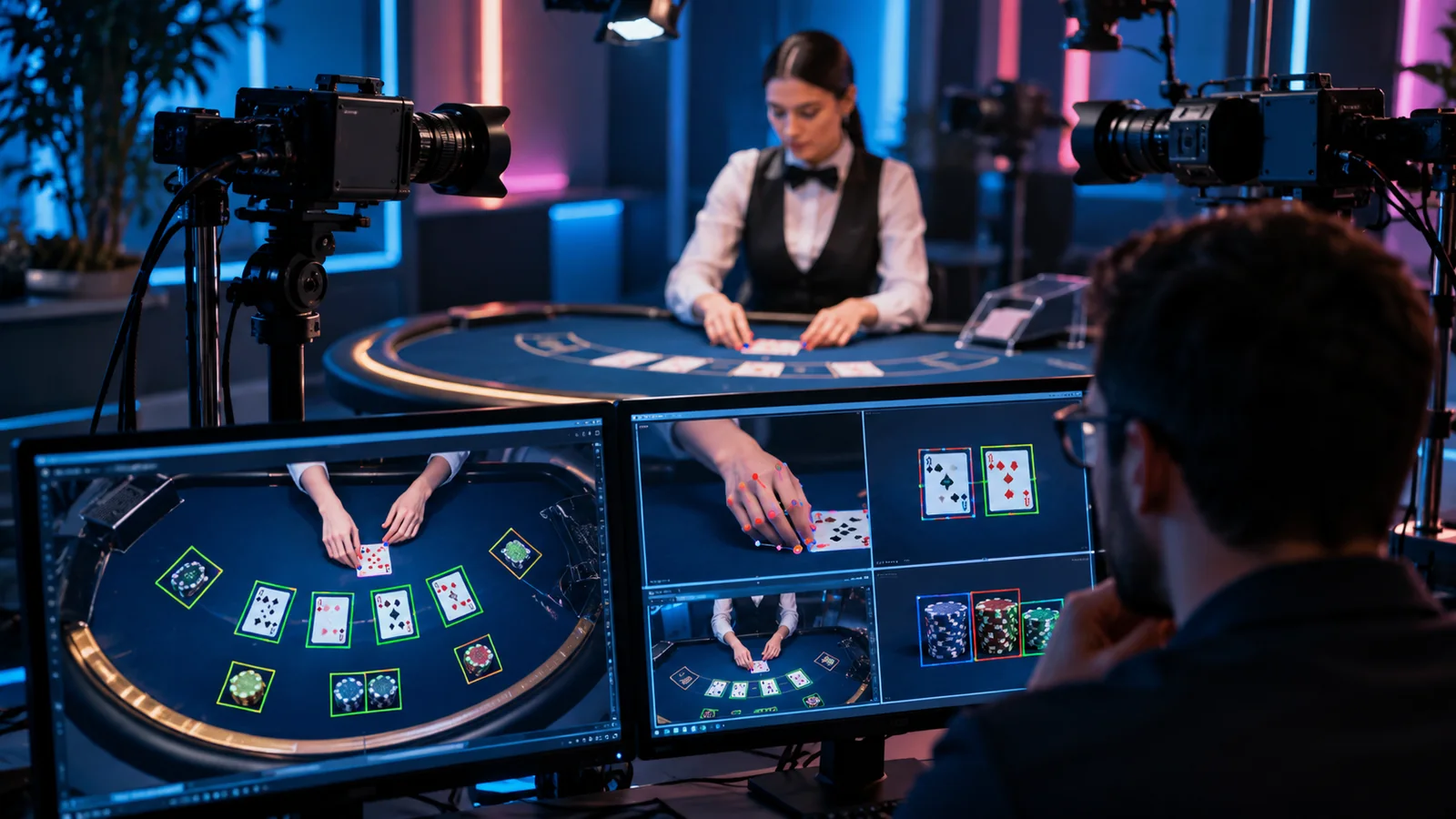
Select the narrowest visual task that solves a problem
| Task | Possible vision output | Required control |
|---|---|---|
| Card recognition | Rank, suit, location and confidence per visible card. | Rule-state check and a manual correction path for occlusion or ambiguous symbols. |
| Chip observation | Token count, colour or denomination mark within a defined region. | Reconciliation against the bet record and a camera-angle calibration. |
| Table-state tracking | Object positions, zones and movement over time. | Timestamped event log, missed-frame detection and recovery after camera reset. |
| Stream quality | Frozen image, missing region, unexpected camera change or low visibility. | Operator alert that does not alter a settled game result by itself. |
| Identity matching | Biometric comparison or classification. | Separate privacy and legal assessment, necessity, safeguards and review before use. |
Observing a card or staff movement does not authorise a model to identify someone. Face matching to an account or behavioural categorisation is a distinct system with separate purpose, access and approval rules. Limit detector output to the operational event it was designed to inspect.
Choose edge or cloud processing with a data-flow map
Processing at the camera can cut transfer delay and reduce raw-video movement, but it adds device-management and local-storage risks. Cloud compute simplifies pooling and updates while raising bandwidth, latency, residency and access questions. A hybrid can detect objects locally and send only a small event record to central review.
Map the route from lens to storage before selecting a model. For every step, identify whether it handles raw footage, crops, feature vectors or event metadata. Note where copies reside, who can reach them, retention periods and closure procedures. Separate production footage from developer datasets; blur or crop areas unrelated to the task.
Even analytics that do not identify people need a data map. Name the recorded room, authorised reviewers, clip retention period and any vendor recipient. If identity matching is added later, require a new privacy assessment before the feature reaches production.
Measure error where the operator needs a decision
Overall accuracy can conceal live-game errors. Separate false detections from missed events, then record calibration, full-path latency, dropped frames and recovery after camera or network interruption. Compare results by camera location, dealer, lighting, table material, deck and compression. Success on a prepared test set is not evidence of studio performance.
Set the uncertainty threshold according to the cost of an error. A stream-health alert can send extra cases to review; an event affecting a customer's balance needs a stricter gate and another source of evidence. Keep successes and failures to compare model revisions. Alongside confidence, show the image region, expected event and reason for the alert.
- Track precision and recall by event and relevant operating condition.
- Measure the time from frame capture to a visible alert or game-state update.
- Count unresolved events and manual corrections, with reason codes.
- Audit model drift when camera, lighting, card design or table layout changes.
- Keep a guardrail for incorrect account adjustments or customer-facing decisions.
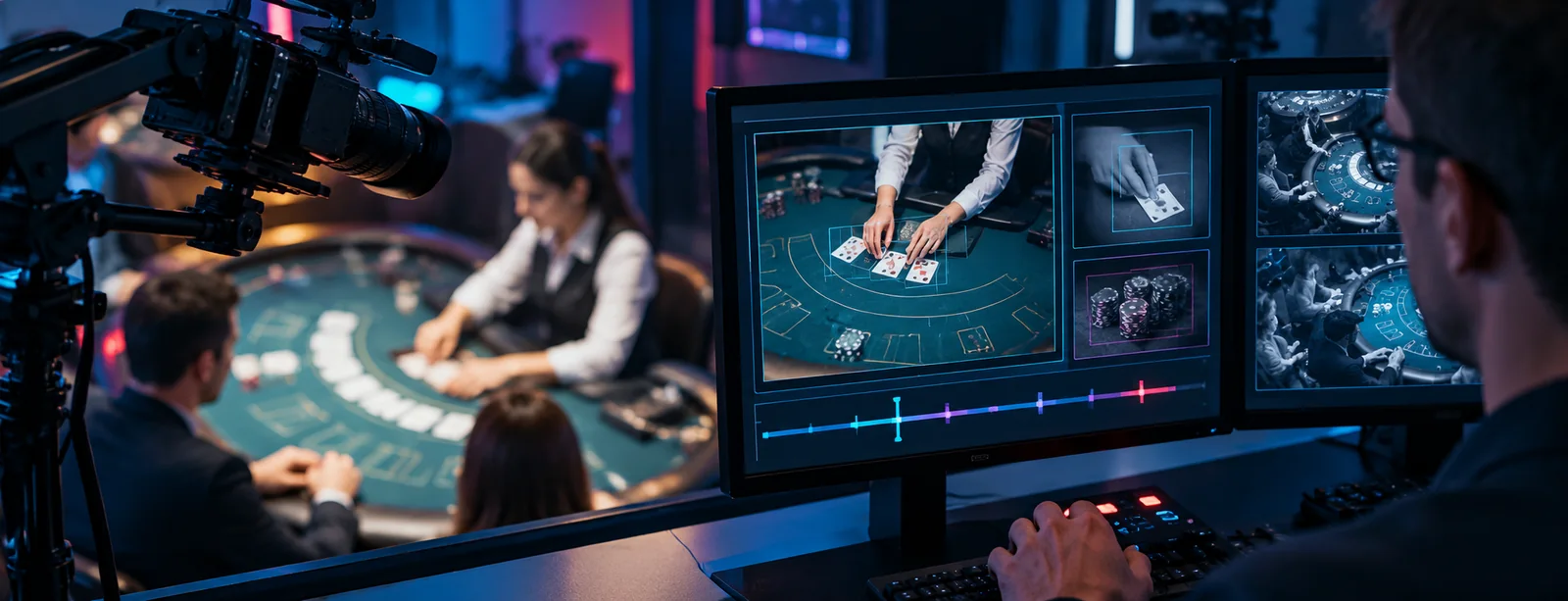
Prevent a monitoring feature from becoming a game controller
Do not connect image permissions to code that chooses or settles a digital outcome. A camera alert may create a review case, but cannot change a random draw or silently block a settled result. Log the visual observation and the authorised operator's separate response.
Route ambiguous or consequential evidence to a person. Give the reviewer the source frame, timestamp, camera health, model output and related game event. Corrections should add a new record with reviewer, reason and prior value intact. Preserve the machine observation instead of overwriting it so an audit can reconstruct both the system's view and the human decision.
Monitoring can expose process gaps, but it cannot replace clear rules, dependable logs, access control or an appeal route. A safer design lets the camera fail without taking down the game service, which can continue to rely on state verified through its own controlled inputs.
Implementation review checklist
Decision record for an iGaming vision feature
- Purpose and boundary
- Evidence to attach:Named event, non-goals, system owner and authority that can accept the event.
- Data minimisation
- Evidence to attach:Camera map, processing location, retention schedule and access roles.
- Model quality
- Evidence to attach:Test data profile, separate error rates, performance by scene and confidence threshold.
- Failure handling
- Evidence to attach:Camera loss, low light, occlusion, network delay and manual review procedure.
- Regulatory alignment
- Evidence to attach:Privacy assessment, game-record mapping and current New Zealand operator obligations.
A table-specific model detects discrete items such as cards or chips. Tracking follows them across frames and ties observations to time and round state. Both can support review, but neither should authorise a wager or settle its outcome.
Make the monitoring output inspectable
Reviewers should be able to reconstruct an event without asking the model owner to interpret a score. Attach frame range, camera position, calibration and detector versions, threshold, game phase and service event ID. Keep an approved pointer to original evidence. A crop speeds review; the permitted full frame can reveal glare, hands or table edges that affected detection.
Model technical health separately from game health. A camera may be online but blocked; a responsive model may return stale output; the game service may be healthy while one table lacks coverage. Give each state an owner, name and alert route. This exposes faults that an empty alert queue could otherwise disguise.
For New Zealand deployments, assign an owner for current online-casino standards and a privacy reviewer for identifiable footage. Use consistent labels across operator, model and support teams: observation, accepted game event, unresolved mismatch and human correction describe different states.